
New York Green Space Restoration
BY Cristiam Cruz
Introduction:
New York City’s tall skylines may be surprising and iconic, but beneath the towering buildings, a different story unfolds. Every year, the weather changes more and more, starting later and lasting longer. Also, each summer, the air quality is worse than the last, making it harder to breathe or be outside in general. “New projections from the New York City Panel on Climate Change (NPCC) confirm that the city will be hotter, rainier, and wetter in the coming years”(THE CITY, 2024). The heat in the city is noticeable and is more 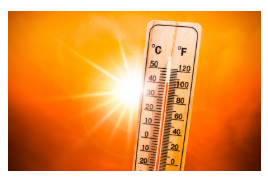
The farther you go from the parks or places with fewer trees and vegetation. In New York City, the poor air quality and constant change in the weather are all
caused by the improper care of our environment and insufficient green spaces. However, there are organizations like the NEW YORK Restoration Project and other organizations that work every day to change that. One way to improve New York City’s weather conditions and environment is to plant more greenery and trees in places in the city where they are needed.
History:
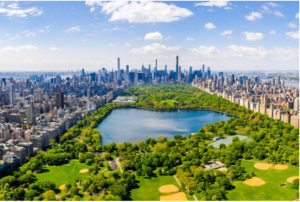
New York’s green spaces share an intertwined history with the proliferation of public parks across America. An even longer tail than that of Central Park leads back to Boston, where, in 1634, the Common was laid out as a grassy pasture and a space for public assemblage. Though we might not think about it, a public park serves a very different purpose from your average private lawn. Collectively, we might imagine that as we traverse the paths of our parks, we are doing something for the very basis of democracy that our Founding Fathers dreamed of(EarthShared, 2024).
(Hotels.com)
In New York and the rest of the U.S, green spaces are becoming increasingly inclusive. Yet, lasting challenges prevent many of our parks from being truly equitable. These areas are often still found in the more affluent parts of town, and many neighborhoods have not seen the kind of investment that would make up for the historical injustices of displacing Indigenous and marginalized communities. That said, there is a lot that can be done to close this gap, and it starts with a community fully invested in the health and safety of its members. You can achieve this kind of community through advocacy, participating in events organized by park nonprofits, and taking part in local government decision-making. The more individuals from diverse backgrounds and perspectives can participate in these spaces, the healthier and more inclusive they can be(EarthShared, 2024).
Benefits:
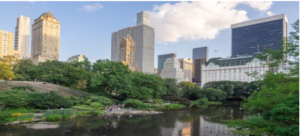
Increasing the quantity of green spaces in the city has many benefits that can improve New Yorkers’ environment and quality of life. Adding more trees to different city zones that are mostly buildings and concrete can help with the heat. “The world’s cities are becoming increasingly congested and polluted (Blanco et al., 2009). Urban green space provides a wide range of ecosystem services that could help combat many urban ills and improve life for city dwellers”(Science Direct, 2014). Green spaces can be used as a tool to fight the city’s pollution. If we plant more plants, we can improve the air quality and mitigate rising temperatures that increase every year. Having more green spaces can also improve the water quality because by having more plants, they will absorb the rainwater and reduce the amount of combined sewer overflows. It also protects lots of areas in the city from floods and nurtures biodiversity.
(Land8, 2021)
Beyond environmental benefits, more green spaces will promote mental well-being and community connections in a way that having more nature will increase the interest of people to go outside. “Green cover has also been shown to protect health (Villeneuve et al., 2012). Additionally, parks often serve as sites of physical activity, which is associated with enhanced health and reduced risk for all-cause mortality and many chronic diseases (Anon,1996).”(Science Direct, 2014). In other words, more greenery enhances overall well-being and reduces stress levels. An example of this can be Caribbean countries like the Dominican Republic or Jamaica, where nature is dominant. The citizens  (Natural Blaze, 2017) tend to be happier and rank higher in the World Happiness Report (Jamaincans.com, 2024). This happiness is obviously on only because of nature but is a big factor when it comes to it.
Organizations:
Planting greenery and protecting our local wildlife doesn’t just come from the State’s efforts; it also comes from different non-profit organizations that use the donations they receive to plant different types of plants, protecting natural environments that are getting contaminated every day, and saving water in their mission. One organization that has been putting in the work to increase the amount of green spaces in the city for more than 30 years is “NEW YORK Restoration PROJECT. Their work is to maintain the city’s parks and community gardens. With urban agriculture and public initiatives like food handouts, live concerts, and other neighborhood-focused events, we help communities activate these green areas all year long.
Counter:
A New York Times report named “A Drawback to Urban Green Spaces”, by Sindya N. Bhanoo, argues that while urban areas are often praised for having environmentally friendly green spaces, a recent study suggests that this may not be the case. A recent study published in Geophysical Research Letters found that city parks, such as those in Los Angeles that require year-round maintenance, may release more greenhouse gases than the green spaces absorb. “A study on urban green space says that the irrigation, fertilizer, mowing, and leaf blowing all add up, emitting more carbon dioxide and other greenhouse gases than the spaces absorb”(The New York TIMES, 2010). Meaning, although there has long been speculation that the maintenance of city parks might generate emissions that offset at least some of the carbon dioxide being captured by the grasses, until now, no comprehensive landscape-level carbon assessment had been conducted for any urban parks. Conducted in Southern California, where lawns receive year-round maintenance, the research raises questions about the actual environmental benefits of urban green spaces.
Conclusion:
To sum up, although there are genuine worries about the environmental expense of upholding urban green areas, the advantages they bring to municipalities such as New York vastly eclipse the negatives.
Far from being simply ornamental, green areas do myriad vital tasks that form the invisible yet critical ecosystem services performed by trees and plants: reducing air pollution, performing stormwater management, lowering urban heat island effect temperatures; and, on top of that, they seem to have a direct positive correlation with the mental and physical health of the people inhabiting the space around them.
The simple presence of a green area can also cultivate stronger, more cohesive communities, as long as locals are willing to serve as the advocates and nonprofits needed to tend to the community garden. Furthermore, now more than ever, as New York faces unfolding climate change impacts, investment in green areas seems a vital public health strategy.
Sources:
Bhanoo, S. N. (2010, April 12). A drawback to urban green spaces. The New York Times. https://www.nytimes.com
Jamaicans.com. (2024, March 22). Jamaica ranked 66th, but still the happiest in the Caribbean – 2024 World Happiness Report. https://jamaicans.com
Fitz-Gibbon, J. (2024, March 4). New climate projections: NYC will keep getting hotter and wetter. THE CITY. https://www.thecity.nyc
Blanco, H., Alberti, M., Olshansky, R., Chang, S., Wheeler, S., Randolph, J., … & Wilson, B. (2009). Urban open space systems and green cities: History, heritage, and all that. Urban Design International, 14(4), 179–196.Urban Open Space Systems and Green Cities: History, Heritage, and All That
EarthShared. (2024). A history of public green spaces and accessibility. https://earthshared.org
New York Restoration Project. (n.d.). Home. https://www.nyrp.org
NYC Mayor’s Office of Climate and Environmental Justice. (n.d.). Green space. Green Space – NYC Mayor’s Office of Climate and Environmental Justice
Wolch, J. R., Byrne, J., & Newell, J. P. (2014). Urban green space, public health, and environmental justice: The challenge of making cities ‘just green enough’. Landscape and Urban Planning, 125, 234–244. https://doi.org/10.1016/j.landurbplan.2014.01.017
Informing Families. (n.d.). Heatwave safety tips and resources. https://informingfamilies.org
Go Guides. (n.d.). Central Park in New York – A botanical oasis in New York City. Central Park in New York – A Botanical Oasis in New York City – Go Guides
Land8. (2021, May 4). 10 ways to increase biodiversity in any design. https://land8.com
Natural Blaze. (2017, February 1). Instantly boost happiness by simply taking a look at the nature around you. https://naturalblaze.com
Reflection
This report on green spaces in New York City has helped me engage thoroughly with several of the course learning outcomes. To begin with, I developed my research skills by collecting and analyzing information from diverse sources. A case in point is my investigation into the origin of Central Park. I delved into not just how it was designed but also why it was vitally necessary to the health of New Yorkers. That deep-dive, historical perspective led me to think more critically about how urban nature impacts public health in a 21st-century, climate-changed world.
I further honed my writing skills and ability to communicate clearly in this medium. I took my findings and organized them in a clear, logical, and coherent manner. I learned to outline. I learned the process of writing a first draft and then revising to clean up all the little things that need to be fixed before something is ready to be shared with an audience. And my audience, I started to realize, was pretty large. The kinds of things we were working on in class—they’re not just minute technical problems that only a few people care about. They’re matters of public concern. They’re our collective well-being.
The third point is that I could engage with the topic on a civic level. Discovering local organizations such as the Trust for Public Land, which works to ensure that everyone lives within a 10-minute walk of a park, helped me to interrogate how green spaces relate to equity and access. It also helped me to interrogate my role in supporting sustainable and inclusive urban planning.
In sum, this project connected the work I did on an academic level to some very real, very pressing global problems. It helped me see a much clearer pathway from college to contemporary citizenship. I used my college research project as a springboard to inform my work as a global citizen.

This entry is licensed under a Creative Commons Attribution-NonCommercial-ShareAlike 4.0 International license.